Judy Boone–Roger Shears relationship
The Curious Incident of the Dog in the Night-TimeJudy Boone–Roger Shears relationship is Judy Boone and Roger Shears’s partnership during Judy’s life in London, where Christopher Boone arrives to live with them. Its decisive turn is the collapse of the shared arrangement: Roger resents Christopher’s presence and the demands it brings, while Judy gives her son a place to stay and eventually leaves with him. The relationship ends not through a quiet parting but through a sequence of arguments and a conspicuous exchange of belongings, as the household’s competing claims become impossible to contain.
Formation and First Reunion
The evidence places the relationship in London after Judy has left her family. When Christopher waits in a garden for his mother, he hears Judy and Roger arriving together. Roger apologizes, while Judy says he should have considered the consequences before making her look foolish. Their exchange introduces an existing strain between them; Christopher then recognizes Judy’s voice and sees her enter the garden with Roger. Their partnership is therefore present at the moment Christopher finds his mother, but the scene also gives it an immediate edge of disagreement.
The relationship is not explained through a full account of its beginnings. Instead, it becomes legible through the shared domestic life Christopher encounters: Judy and Roger occupy the same flat, and Roger’s home is where she tries to accommodate her son. The story’s close focus on what Christopher sees and hears makes the partnership visible through practical decisions and overheard disputes rather than through an independent account of either adult’s private feelings.
A Household Under Strain
At breakfast, Roger says Christopher can stay for a few days, while Judy insists that he can stay as long as he needs. Roger objects that the flat is barely large enough for two people, let alone three, and says there is no school for Christopher to attend and that both adults have jobs. Judy answers that Christopher can understand what Roger is saying. The disagreement sets out their contrasting positions: Roger treats Christopher’s arrival as an impractical burden on the household, while Judy asserts his presence as a responsibility she will not limit to a brief visit.
The strain becomes more explicit when Judy loses her temporary job. Her workplace tells her that someone else has been hired to do it; she is angry and intends to complain, while Roger dismisses the job as temporary. Later, after drinking, Roger comes into Christopher’s room and reproaches him for failing to think about other people. Judy intervenes and takes Roger out of the room, then apologizes to Christopher. The sequence links financial and domestic pressures to a sharper personal conflict, while showing Judy attempting to protect her son from the argument.
Separation and Its Aftermath
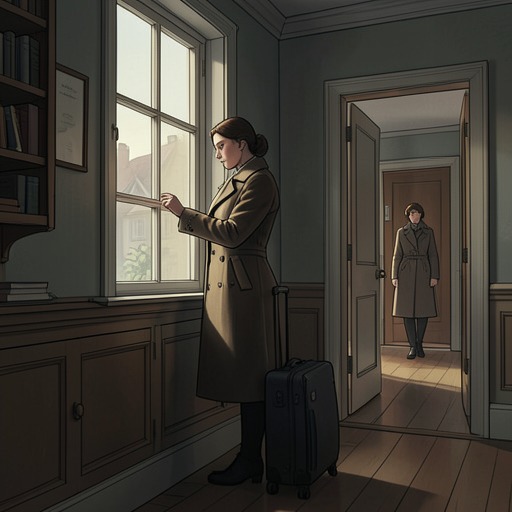
The next morning, after Roger has gone to work, Judy packs clothes into two suitcases, tells Christopher to bring Toby, and takes Roger’s car. She calls it borrowing rather than stealing. On the drive back to Swindon, she explains that remaining in London longer might have led to someone getting hurt, though she does not necessarily mean Christopher. Her decision ends the shared household: she leaves Roger’s home with her son, and the move is presented as a response to the escalating situation rather than as a settled, orderly plan.
Roger’s later conduct confirms the break. During Christopher’s mathematics A-level examinations, Roger arrives by taxi and throws a cardboard box of Judy’s possessions onto the lawn. Among its contents are a hair dryer, shampoo, food, two books, and a framed photograph of Christopher; the frame’s glass breaks when it lands. Roger then drives away. Judy runs into the street, tells him not to come back, and throws the box of muesli at his car. Mrs. Shears watches from her window. The returned belongings and the broken photograph make the separation materially visible: what had been a disputed household arrangement has become an open rupture.
Significance of the Relationship
The partnership’s conflict is inseparable from Judy’s attempt to provide for Christopher. Roger’s concern about space, work, and the feasibility of keeping him in the flat is set against Judy’s insistence that Christopher may stay as long as he needs. When the arrangement deteriorates, Judy leaves with Christopher rather than continuing to negotiate his place in Roger’s home. The relationship’s ending therefore changes the practical circumstances of both mother and son, as well as confirming that Roger and Judy no longer share a household.
The account remains bounded by Christopher’s viewpoint: the reader encounters the relationship in overheard speech, household decisions, and visible actions, not through direct access to either adult’s inner account. Its strongest evidence is consequently concrete—the competing terms of Christopher’s stay, Judy’s intervention, the departure with suitcases, and Roger’s return of her belongings. That restricted perspective gives the breakup its particular shape: a private partnership is understood through the consequences it produces in the space Christopher must inhabit.